April 2026
Cities Take the Lead on Climate Action: Economic Urgency and Urban Reality
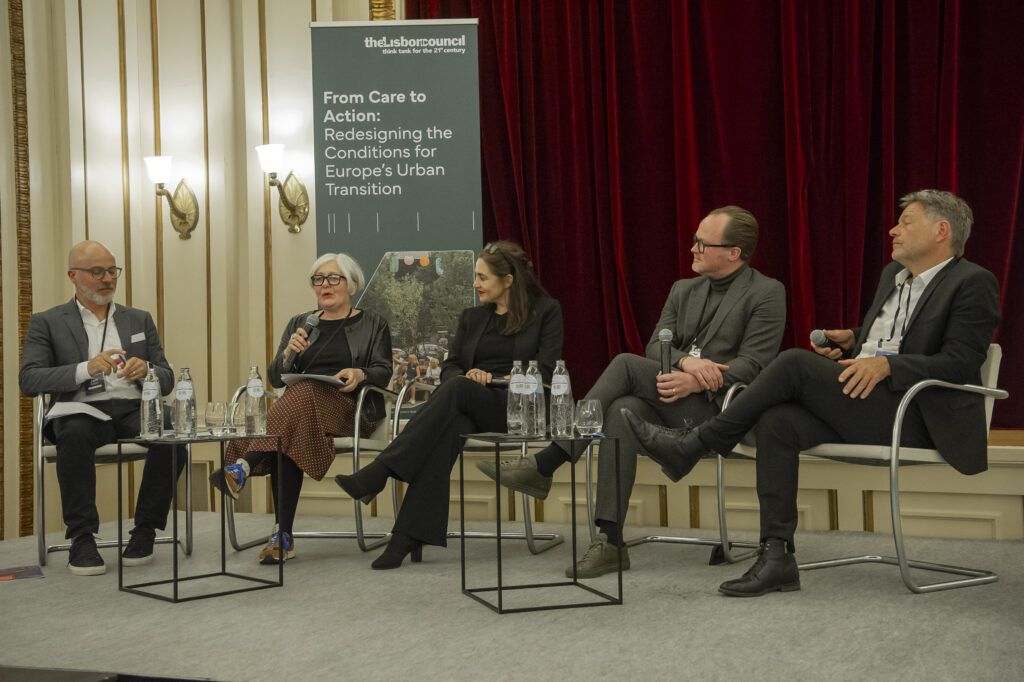
There is no secure and competitive Europe without sustainability. And European cities now sit at the centre of the green transition: they are the primary markets for clean industry and the places where high-level European Union targets must be reconciled with the daily realities of housing, energy and mobility. While around 70% of European Union legislation is implemented at the local level, a persistent gap remains between climate ambition and actual delivery. To explore how to bridge this gap and turn policy into practice, the Lisbon Council convened the 2026 Sustainable Cities Summit on ‘Squaring the Green Circle: Climate Action, Economic Urgency, Urban Reality,’ bringing together leading policymakers, city practitioners, investors and urban innovators.
The summit opened with a High-Level Roundtable on ‘Scaling Sustainability in a Tougher Climate: What Europe’s Cities Have Learned and What Comes Next,’ a candid, peer-to-peer exchange between senior city leaders and experts. From the lived experience of key cities, including Brussels, Cluj-Napoca, Copenhagen, Firenze, Ferrara, Hamburg, Leuven, Madrid and Riga, the discussion highlighted what can realistically be replicated and scaled across diverse urban contexts.
The conversation continued in the afternoon with a plenary session that brought these important local insights into a broader policy and strategic perspective. Robert Habeck, former vice-chancellor and federal minister for economic affairs and climate action of Germany, delivered a keynote on the need to secure Europe’s social contract through industrial and urban renewal, underlining the growing link between sustainability, resilience and economic security. Belinda Tato, professor at the Harvard Graduate School of Design and co-founder of ecosistema urbano, also presented her work on designing inclusive and climate-responsive urban environments, demonstrating how co-creation and citizen-centred approaches can make sustainability tangible in everyday life.
High-level contributions from Thure Krarup, head of global public affairs and policy at Urban Partners, further explored how cities can unlock private capital, structure investable projects and deliver transformation at scale. Laurence Graff, adviser for multi-level climate action and European climate pact, directorate-general for climate action, European Commission, wrapped up the Summit, reflecting on the role of European policy in enabling cities to strengthen resilience and maintain Europe’s global leadership in sustainable urban development.
The summit also served as the platform to launch the Sustainable Cities Lab, a new initiative by the Lisbon Council designed to bridge the gap between innovation and implementation. The Lab draws on research insights and on-the-ground experiences of a diverse portfolio of Horizon Europe projects, including URBREATH, BLOSSOM and URBAN-FLOW, as well as a network of over 100 partners across 24 cities. Bringing together key contributors working at the forefront of urban transformation, it aims to translate urban experimentation into actionable policy and scalable delivery models with special contributions from Engineering and DEDANEXT on system integration, Institute of Communication and Computer Systems (ICCS) on artificial intelligence and data analysis, Plusvalue on bankability and Politecnico di Milano on co-creation, Climate KIC and OASC on the links with cities. The Lab’s first policy brief, From Care to Action: Redesigning the Conditions for Europe’s Urban Transition, provides a framework for aligning citizens, capital and institutions to turn climate ambition into lasting impact.
Together, the discussions at the 2026 Sustainable Cities Summit underscored a central message: Europe does not lack ideas or ambition. What it needs are the conditions to act: robust governance models to secure citizens’ buy-in, de-risked financing structures to mobilise private investment and institutional capacity to deliver climate action where it matters most: in cities, in real time and at scale. Through the Sustainable Cities Lab, the focus moves from what must be done to how we deliver.
Download From Care to Action: Redesigning the Conditions for Europe’s Urban Transition.