December 2025
Europe’s Quantum Shield: Securing Tomorrow, Today
Quantum technologies are the next technological breakthrough after artificial intelligence. They promise to optimise shipping routes, financial modelling, materials science, defence systems and space operations. Yet, this progress will pose significant security risks for today’s cryptography with experts warning that cryptographically relevant quantum computers could expose personal communications and data as early as 2030-2035, especially in light of the Harvest Now, Decrypt Later strategy. Europe has the talent, research capacity, specialised startups and applications to lead a responsible quantum transition but doing so will require coordinated, cost-effective action across sectors.
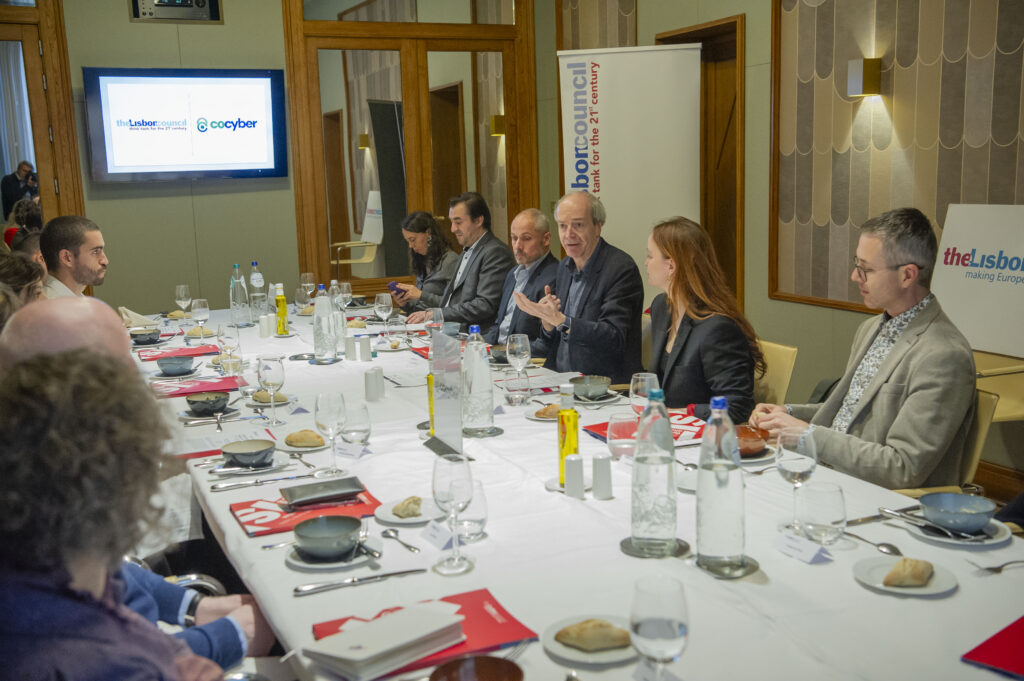
With the question no longer whether Europe should act but how, the Lisbon Council convened the High-Level Working Lunch on ‘Europe’s Quantum Shield: Securing Tomorrow, Today,’ bringing together technical experts and policymakers to chart a path forward. Dr Bart Preneel, full professor, computer security and industrial cryptography group, KU Leuven, opened the discussion. Other high-level participants included Christian D’Cunha, head of unit, cyber coordination task force, directorate-general for communications networks, content and technology, European Commission; Karolina Kozłowska, support action coordinator, European Union Agency for Cybersecurity (ENISA); Juraj Kubica, seconded national expert, directorate-general for communications networks, content and technology, European Commission; Fabienne Marco, head and co-founder, Quantum Social Lab, Technical University of Munich Think Tank; and Jan Sonck, quantum community lead, The Quantum Circle; quantum innovation lead, Proximus group.
The roundtable was convened within the framework of the COcyber project, a two-year European initiative aimed at strengthening collaboration and coordination between the civilian and defence cybersecurity sectors.