February 2026
No Bully Zone: Europe Fights Cyberbullying
It has been some time since society learned to identify and call out bullying. Yet, as teenagers’ social interactions have increasingly moved from school halls to online spaces, bullying has become borderless and contactless and yet more invasive than ever. It is a digital shadow that follows teenagers everywhere they go with severe consequences for the mental health of its victims. Grouped under the umbrella term cyberbullying, we must look at this phenomenon closely, including at its cultural and behavioural roots, and address it in its complexity rather than treat it as a question of mere content moderation.
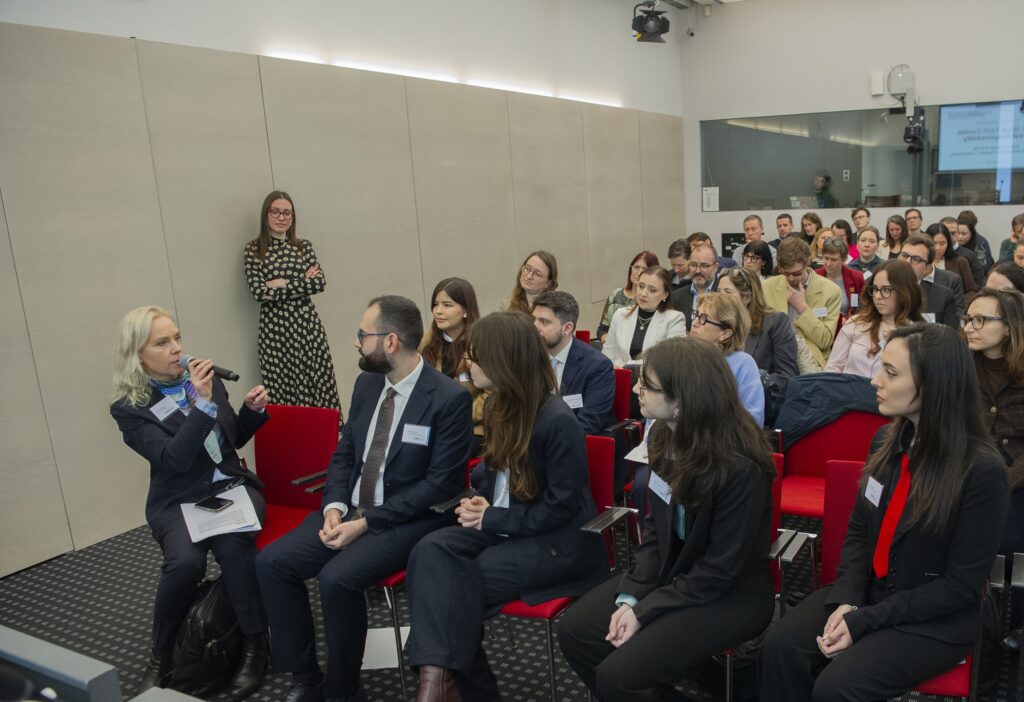
As the European Commission steps up efforts with the launch of a new European action plan on cyberbullying and momentum builds around the idea of a European social media ban for teenagers, the Lisbon Council convened the High-Level Roundtable on ‘With Great Tech Comes Great Responsibility: Why Young People’s Leadership is Crucial to Fight Cyberbullying and How the New European Action Plan Can Help.’ The high-level roundtable focused on the practical solutions for a safer online environment: one that is both fit for, and shaped by, young people.
At the roundtable, Deputy Head of Cabinet for Commissioner Micallef Johanna Bernsel discussed what is still needed to turn policy into impact. To bridge the policy discussion with grassroots innovation, the roundtable also welcomed the student winners of The Big Hack 2025, a technology hackathon and coding marathon by Apple Academy. Students showcased two winning applications: 5Detect, an innovative augmented-reality tool that allows young users to explore different actions and reactions to cyberbullying; and Etherpath, a cutting-edge educational game concept that explores the emotional impact of actions online.
Other high-level participants included Stefano Avallone, associate professor, University of Naples Federico II and managing director, Apple Developer Academy; Elizabeth Gosme, director, COFACE Families Europe; and Hans Martens, head of digital citizenship, European Schoolnet, who deep dived into the legislative, family, educational and technological angle of this important issue.
The roundtable also served as a platform for the announcement of Evidence Hub on Social Media Ban on Kids, a soon-to-launch information hub of visualised data and opinion pieces by leading experts in online safety, children’s protection and digital rights.